Why do we need to optimize HPC storage systems?
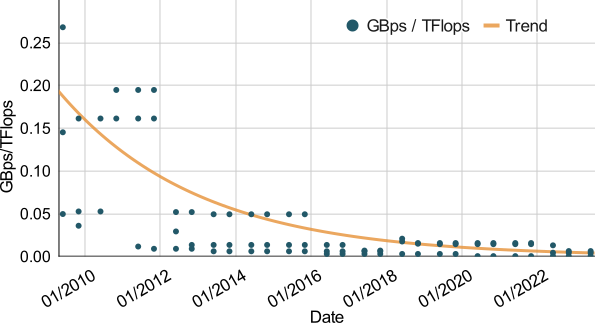
Ratio of I/O bandwidth (GBps) to computing power (TFlops) of the top 3 supercomputers from the Top500 ranking over the past 15 years.
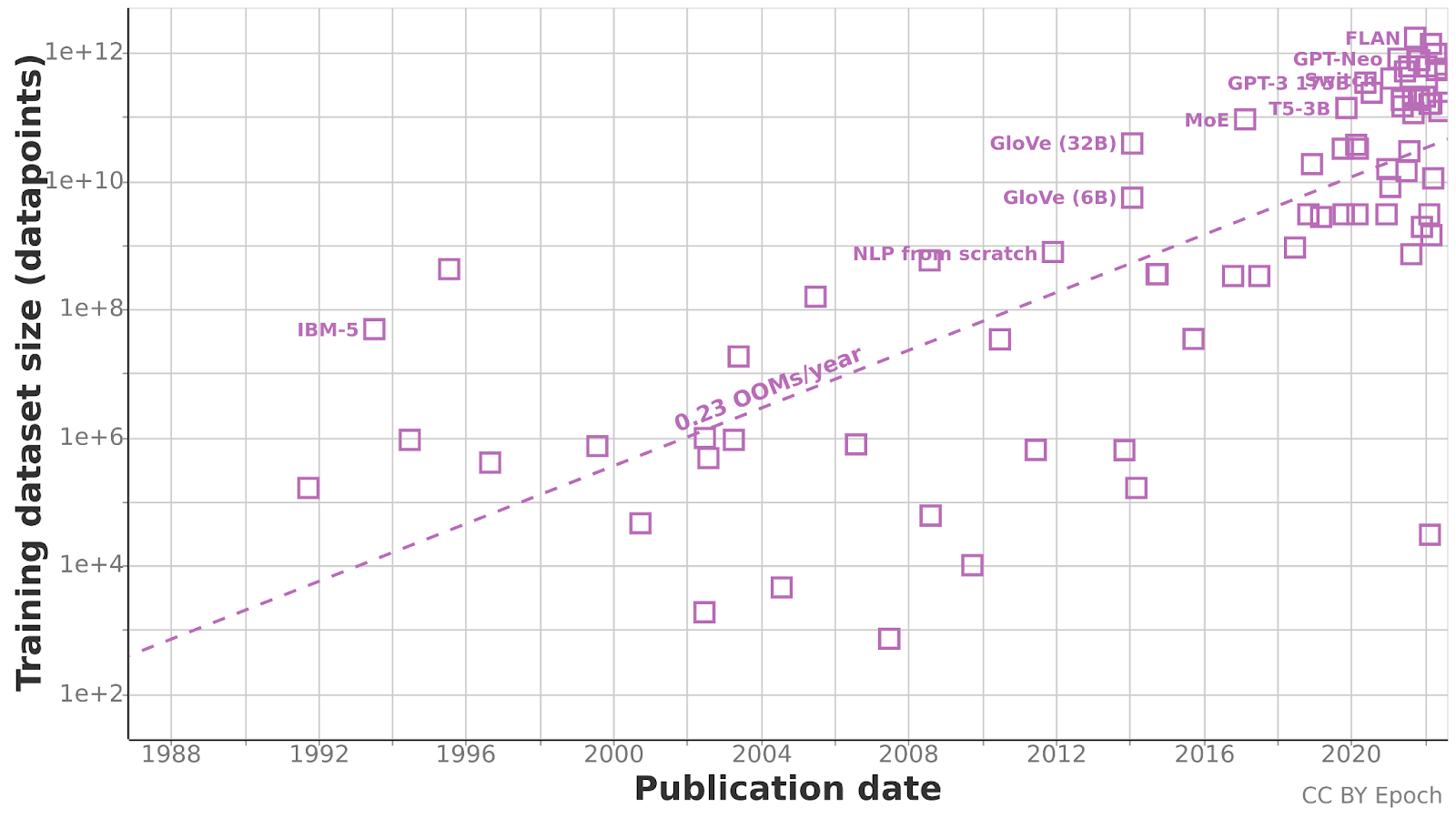
Evolution of training dataset's sizes for machine learning applications.
Pablo
Villalobos and Anson Ho (2022) "Trends in Training
Dataset Sizes"
How to optimize storage access on supercomputers?
Multiple ways of achieving I/O efficiency (non exhaustive):
- Application level: use of advanced I/O mechanisms in applications' codes.
- I/O library level: I/O optimizations inside libraries to transparently perform operations efficiently.
- Scheduler level: make smart scheduling decisions to avoid concurrency between jobs.
- Storage level: adopt I/O-aware policies (e.g. data distribution) within the parallel file system (PFS).
We introduce MOSAIC: an I/O-aware categorization tool able to describe access
patterns from I/O traces, including: access temporality, periodicity and metadata overhead.
Fundamental prerequisite: have a good understanding of how HPC applications behave.
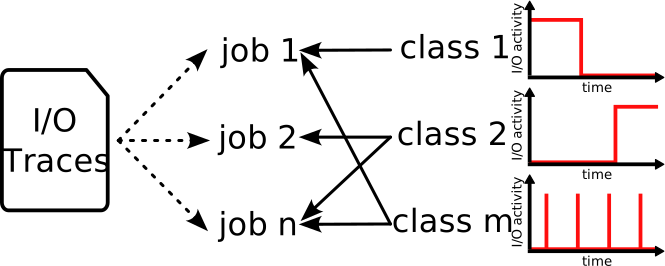
Trace processing methodology
MOSAIC trace processing workflow
Pre-processing: go through every Darshan trace file to retain only one representative trace for each unique execution (user, execution cmd).
Merging: fuse concurrent operations and close neighbors to have a linear list of operations (the start of the next operation is after the end of the previous one).
Categorization: process the traces to assign classes about metadata patterns, operation periodicity and access temporality.
Export: save the results in a JSON file for each processed trace. It contains execution metadata, assigned classes, and list of operations with periodicity.
Merging of neighboring operations
- Take the list of operations.
- Find the inactive periods higher than a fraction of the average idle time between two operations.
- Merge operations between those periods.
Detection of recurring operations
- Take the list of merged operations.
- Create segments from the start of a merged operation to the start of the next one.
- Run MeanShift clustering algorithm to group similar segments. All the segments in the same group are considered as being part of the same periodic operation
Detection of activity's temporality
- Take the list of merged operations.
- Split the trace into four chunks of equal length.
- Compute the amount of Bytes operated in each chunk.
Detection of metadata activity
- Take the list of operations.
- For each operation, put the OPEN and SEEK operations at the beginning of it, and the CLOSE at the end.
- Assigns the classes if one or multiple spikes (over a threshold) are present, if multiple operations are done in a window of multiple seconds.
Results from Blue Waters' traces (year 2019)
Blue Waters
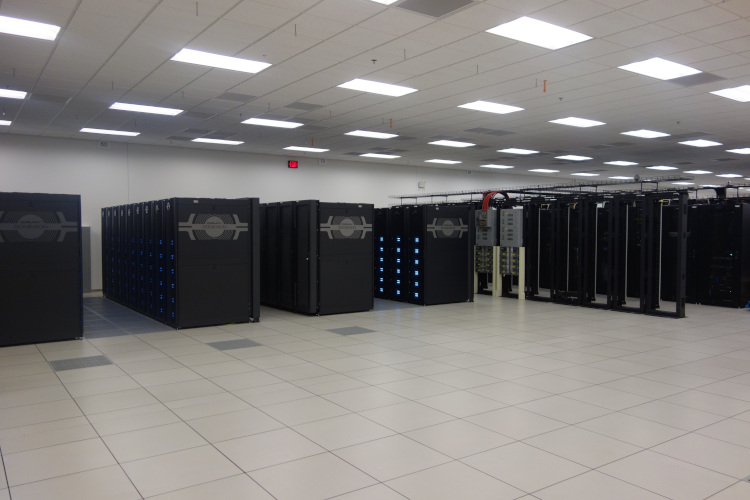
- Petascale supercomputer managed by the National Center for Supercomputing
Applications
(NCSA) at the University of Illinois.
- Operated from 2013 until late 2021.
- 27k nodes, 49k CPUs
- 25PB of storage managed by Lustre
- By default, all jobs running on Blue Waters were monitored by Darshan. Traces from 2013 to 2019 are publicly available.
- The traces contain the full list of operations, meaning one can estimate the I/O activity produced by monitored jobs.
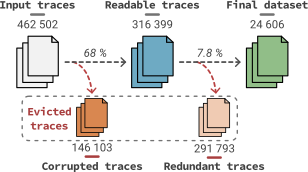
Trace Processing flow (Blue Water, year 2019)
Temporality classes distribution (read)
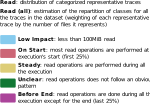
Most represented read classes for categorized traces.
Estimation of the most represented read classes for all traces.
Temporality classes distribution (write)
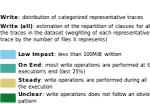
Most represented write classes for categorized traces.
Estimation of the most represented write classes for all traces.
Periodicity classes distribution
Estimation of the executions with periodic read operations.
Estimation of the most represented periodic write classes for all traces.
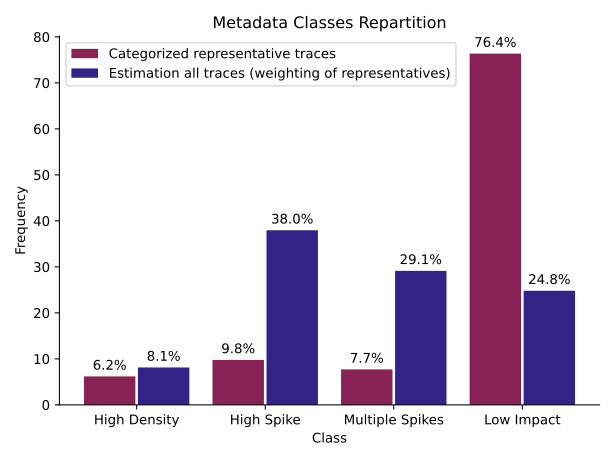
Metadata classes distribution
Classes frequently assigned together
Some notable associations:
- 95% of applications having no impactful read activity also has no impactful write activity (4-9).
- 66% of applications reading at the start also writes at the end (5-10).
- Periodic reads mostly have a period around the second (62%, 6-7), whereas periodic writes usually have a period around the minute or longer (74%, 11-12 and 11-13).
Conclusion
Contributions:
- A methodology to detect recurring operations based on clustering: we have worked on a clustering-based algorithm that groups operations based on their characteristics.
- A set of classes to describe I/O patterns: we defined a set of high-level classes characterizing the access patterns found in I/O traces.
- The implementation of a Python tool to categorize Darshan traces: we created MOSAIC, a tool that automatically processes Darshan traces to assign classes and get insights about the way HPC applications access the storage system.
- A case study using year 2019 of the Blue Waters Darshan dataset: we categorized the traces from 2019 in the Blue Waters dataset and analyzed the distribution of classes to see how the storage system was used by the applications.
Limitations
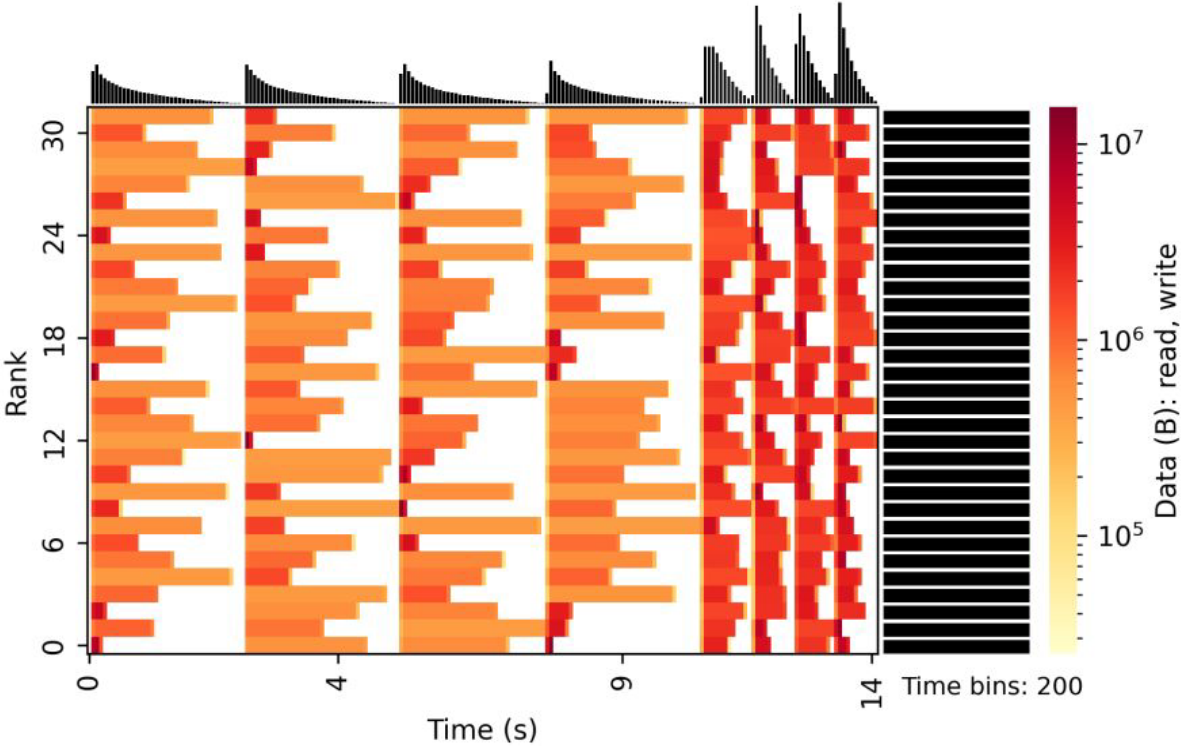
Example of Darshan heatmaps.
Source: Exascale
Computing Project
Main limitations:
- Operation aggregation: operations are aggregated in Darshan traces from the first open to the last close of a file by a rank (or group of ranks). This loss of accuracy can lead to an underestimation of periodic operations.
- Recent dataset availability: there are very few publicly available Darshan datasets for a whole system.
Future Work and Perspectives
Improvement Work:
- Change input trace format: use Trace Event File format as input to make Mosaic agnostic from the tracing tool.
- Improve selection of representative traces: consider the number of operations in each trace to group together traces with roughly the same amount of operations.
- Further improve the definition of thresholds: some thresholds were defined empirically from the Blue Waters dataset, we'd like to refine them to ensure they are relevant in general cases.
Perspective:
- I/O-optimized scheduling: feed the I/O classes to a scheduler when submitting a job. The scheduler can then adopt strategies to avoid contention on the PFS.